
Introduction
We hope this guide will answer your questions about Uroflow Study. Please contact the team if you require further information via the details at the end of this leaflet.
What is a Uroflow Study?
A Uroflow Study (or Uroflowmetry) is a test to see how fast and how much urine you pass when passing urine normally.
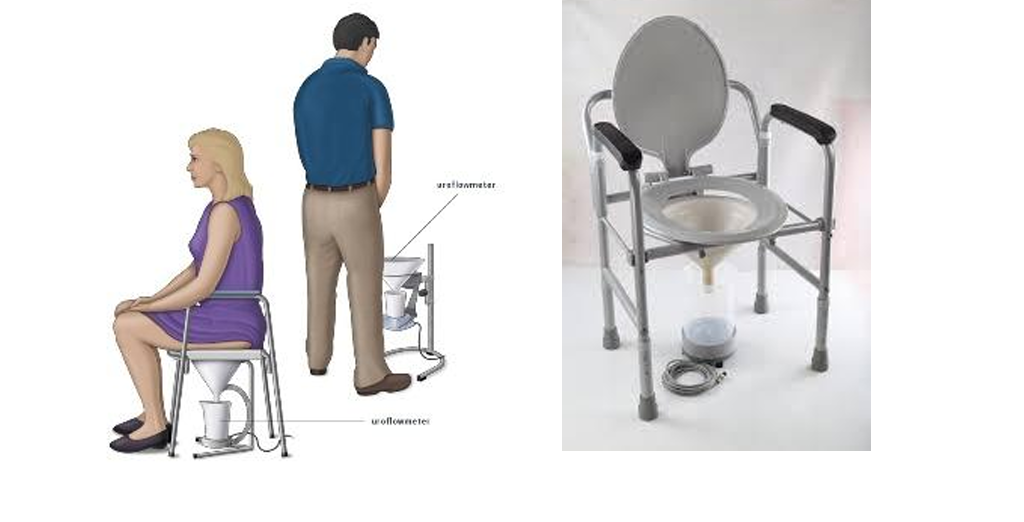
Uroflow is a non-invasive investigation where you pee into a special container which then records the flow rate of the urine passed, the duration (how long it takes for you to pass urine), and your flow pattern, for example if it is a continuous flow, or an interrupted flow.
Why do I need a Uroflow Study?
A Uroflow Study is helpful if you experience lower urinary tract or bladder emptying problems such as;
- benign enlarged Prostate
- narrowing (strictures) of the urethra
- neurological conditions that affect the bladder such as Multiple Sclerosis, Parkinson’s Disease, or following spinal injury
- frequency, hesitancy or urgency
- incomplete bladder emptying
- slow or weak flow that stops and starts
- recurrent urine infections
A Uroflow Study will help your doctor better understand how your bladder, sphincter and urethra are working, which is important when diagnosing any potential blockages, muscle weakness or nerve problems that could be causing your symptoms.
What happens during a Uroflow Study?
A Uroflow Study involves you peeing into a special funnel and container that records the speed, the volume and the duration of your peeing.
There are no special requirements in preparing for a Uroflow Study except that you should aim to arrive at your appointment with a full, or partially full bladder.
It is important that you try to keep your bladder full/ partially full and that you do not urinate prior to arriving for the test. If on arrival you are having difficulty in holding your urine in, please let the nursing staff know when you arrive to the unit.
If you are not quite ready to pass urine when you arrive then you will be able to have a few cups of water to ‘Top-Up’ to allow you to undertake the test.
Depending on how much urine you pass when attempting the test, you may be asked to do a second test as it is important to have enough data for the consultant to make a decision about any future plans.
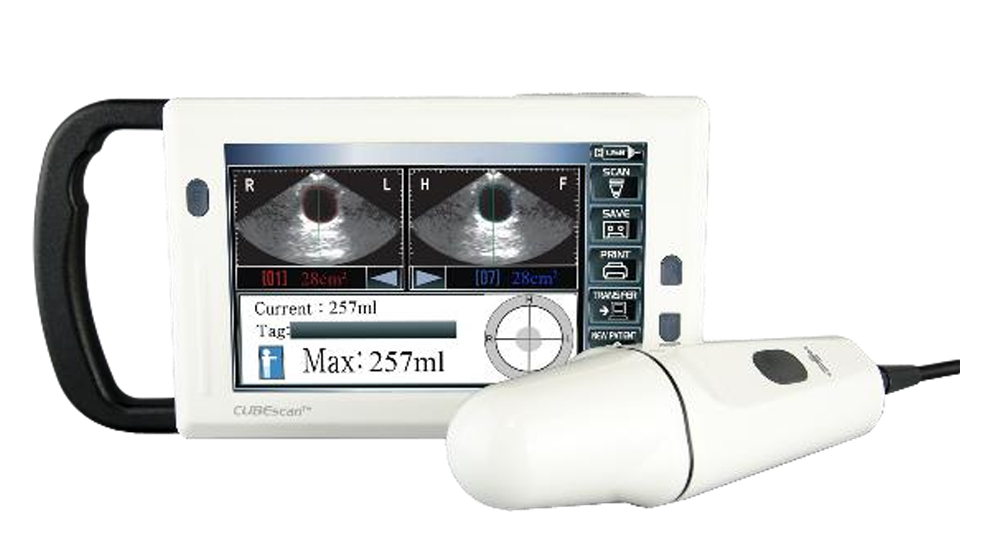
Once you have completed the Uroflow Study, you will have a bladder scan to see how much is left in your bladder.
Depending on how much still remains, you may be asked to try and attempt to pass some more urine, and the nurse will repeat the bladder scan.
What happens next will depend on how much urine is left in your bladder. The nurse attending to you will discuss this with you in more detail at the time.
Are there any risks to having a Uroflow Study?
There no risks to undertaking a Urolfow Study.
How long does a Uroflow Study take?
The actual test only takes as long as it takes for you to pass urine, but depending on whether or not you are ready to pass urine when you arrive, and how much you pass on the test, you could be waiting for a while.
Once you have completed the Uroflow Study, you will have a bladder scan, which again only takes a few minutes to carry out. But, if there is still a large volume of urine in your bladder, you may be asked to stay a while longer to try and pass some more urine. Overall, expect to be in department for around an hour.
The results of the Uroflow look similar to the picture below;
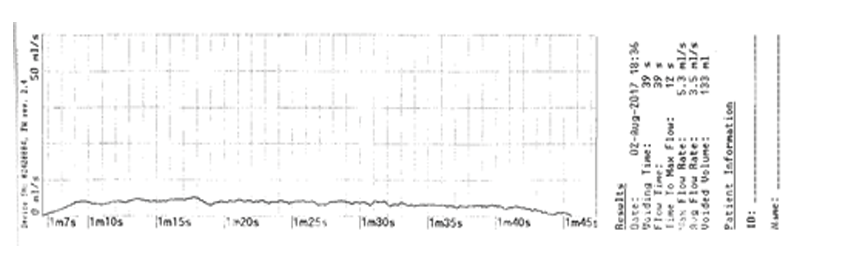
Following the study, an appointment will be made for you to have to meet with your consultant, who will give more detailed feedback on your recording/ results, and discuss with you any plans required to help with your particular situation.
What should I expect after a Uroflow Study?
There is no special care required after a Uroflow Study, however, depending on how much urine is left in your bladder after the study, the nurse attending to you may offer some practical advice on how to improve your bladder emptying or recommend an alternative plan to manage large volume storage problems.
Contacting the team
If you have any further questions, please contact the Urology Booking Team on:
Telephone – 01279 962391 or 01279 952807
Office hours: 09:00 to 16:00
There is an answerphone available outside of these hours. Please leave a message and a member of the team will contact you.
If you would like this leaflet in another language or format, or you would like to give feedback on your care, please contact our patient experience team on [email protected]