
Introduction
We hope this guide will answer your questions about Urodynamic Study. Please contact the team if you require further information via the details at the end of this leaflet.
What is a Urodynamic Study?
A Urodynamic Study (UDS) is a test to see how well your bladder functions, specifically how your bladder stores and releases urine.
UDS is performed by passing a thin catheter into your bladder (to measure the Bladder Pressure), and another thin catheter with a balloon sensor into your rectum (to measure your Abdominal Pressure).
This helps to provide clinical data on your bladder function which is extremely important
to help your doctor diagnose the causes of your symptoms.
Why do I need a Urodynamic Study?
A UDS helps your doctor to diagnose the cause of your bladder problems such as;
- urinary incontinence
- painful urination
- leaking or dribbling of urine on coughing
or sneezing - frequency
- a feeling of urgency
- difficulty in starting to urinate
- incomplete bladder emptying
- slow or weak flow that stops and starts
- recurrent urine infections
A UDS will also help your doctor better understand the pressures at which your bladder fills and empties; whether there is over activity, and how much your bladder can store before you feel the urge to urinate.
What happens during a Urodynamic Study?
Before the UDS begins, you will be asked to pass urine into a uroflowmeter. This will help better understand the flow, volume and speed at which you pass urine. It will also allow us to test your urine for any signs of infection that may be present. If there is a suspicion that you may have a urine infection, we would not be able to carry on with the UDS. Instead, we will send a sample of your urine to the laboratory to see what infection may be present, and rebook your appointment for UDS in a couple of week’s time. You may be given some antibiotics to take home with you, or we may wait until the results of the test to see which antibiotics would be the most appropriate.
Assuming that your urine is clear, you will then be asked to remove your lower half of clothing and given a gown to wear.
Prior to starting the study, we may do a bladder scan just to see if there is any residual urine in your bladder. If there is more than 50ml still in your bladder, we will need to insert a catheter to empty your bladder fully otherwise the results of the study will be incorrect.
Before inserting the catheters, your genital area will be cleaned with sterile solution. We will also use a lubrication gel that has an anaesthetic and an antimicrobial included. This will help reduce the sensitivity on your urethra and reduce the risk of infection.
Once the catheters are in place, we will then connect them to the Urodynamic Machine, and fluid will be slowly instilled into your bladder. You will be able to see the graphical representation on the machine.
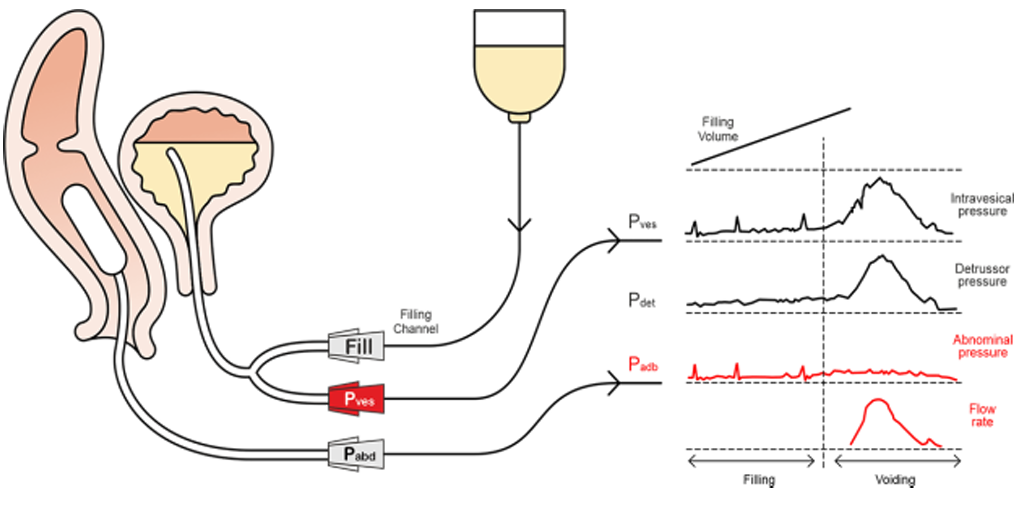
There are 3 key stages to the procedure which the nurse carrying out the study will ask you to confirm;
- 1st stage is a vague sense or awareness that there is some fluid in your bladder
- 2nd stage is a feeling that you want to pass urine but it is not urgent
- 3rd stage is a stronger feeling that you want to pass urine but could possibly hold it a little longer
When you feel you cannot hold it any longer we will stop filling.
Periodically, we will also ask you to cough, as coughing creates a sudden, temporary increase in abdominal pressure, which allows your doctor to see what is happening to your bladder and sphincter muscles. Once we have finished filling your bladder, you will be allowed to pass urine.
Do I need to prepare for a Urodynamic Study?
UDS does not require any special preparations however, you should arrive with a partially or full bladder. You may need to stop taking certain medicines; a list of which medications you would need to stop will be sent to you when your appointment is confirmed.
Are there any risks of having a Urodynamic Test?
UDS have no major risks, although you could see some blood in your urine initially after the procedure, or you may experience some low abdominal pain, or develop a urine infection.
However, your nurse will talk you through what to do should you experience any of these before leaving the department.
What should I expect after a Urodynamic Study?
After your UDS you may have some mild discomfort on passing urine, which is mostly associated with the gel used, but drinking water will help flush this through and reduce the discomfort.
You should avoid drinking any fizzy drinks, caffeinated drinks or alcohol on the day of your UDS, as these can cause some discomfort, but from the following day you should be ok to drink as normal.
The UDS report will be sent to your doctor, and an out-patient appointment will be made for you to receive the detailed feedback from the report and to discuss what further treatment or investigations may follow.
In the few days after the UDS if you experience any flu-like symptoms, burning pain on passing urine, a high temperature, or your urine appears cloudy and/ or smelly, you should contact your GP as you may require some antibiotics.
Contacting the team
If you have any further questions, please contact the Urology Booking Team on:
Telephone – 01279 962391 or 01279 952807
Office hours: 09:00 to 16:00
There is an answerphone available outside of these hours. Please leave a message and a member of the team will contact you.
If you would like this leaflet in another language or format, or you would like to give feedback on your care, please contact our patient experience team on [email protected]