
Reducing the risk of Venous Thromboembolism (VTE) in patients admitted to hospital (202kB pdf)
What is VTE?
Venous thromboembolism (VTE) is an umbrella term for DVT and PE. VTE is a potentially life-threatening condition.
Blood clotting is an important process the body uses to stop bleeding when we cut ourselves or are injured. The body normally balances itself to ensure the clotting process is kept in check. However, there are times when this process can go wrong, and blood clots form inside our veins causing Deep Vein Thrombosis (DVT) or Pulmonary Embolism (PE). Blood clots are more likely to form when people are immobile or have risk factors for VTE, for example when in hospital or having cancer.
Who is at risk of VTE?
Risk factors associated with developing blood clots include:
- Recent hospital admission (up to 90 days post discharge).
- Previous history of thrombosis.
- Recent major surgery, (up to 90 days post discharge).
- Severe trauma, such as a car accident.
- Injury to a vein that may have been caused by a broken bone or severe muscle injury.
- Cancer and cancer treatments.
- Contraceptive pill for birth control or hormone replacement therapy.
- Pregnancy (including six weeks after the baby is born).
- A family history of blood clots.
- Obesity.
- Long periods of inactivity.
DVT (deep vein thrombosis)
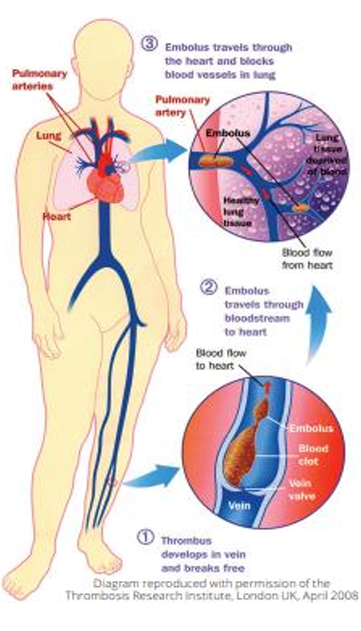
Deep vein thrombosis (DVT) is a common medical condition which occurs when a thrombus (blood clot) forms in a deep vein, usually in the leg or the pelvis. DVT can block off or reduce the flow of blood in the vein.
DVT in the leg or the pelvis can cause pain and swelling in the leg and may result in lifelong disability with painful leg swelling, varicose veins and leg ulcers.
Signs and symptoms of DVT include:
- pain or tenderness in the leg /arm
- swelling usually in one leg (or arm)
- leg (or arm) warm to touch
- Redness and inflammation.
PE (pulmonary embolism)
Sometimes the DVT (blood clot) in the leg breaks off and travels to the arteries of the lung where it will cause a pulmonary embolism (PE). PE may cause breathing difficulties and chest pain, and may be fatal.
Signs and symptoms of PE include:
- Shortness of breath or difficulty breathing.
- Difficulty taking deep breaths
- Chest pain
- Feeling faint or sudden collapse.
How do we try and prevent VTE in hospital?
If you are considered to be at risk of VTE, your doctor may prescribe you an anticoagulant medicine called enoxaparin, which is an injection administered into the abdomen. Possible side effects of this medicine include bruising at the site of injection and prolonged bleeding if you cut yourself. Enoxaparin is of animal origin (pork) but there is a non-animal alternative available if you prefer not to have enoxaparin. Please discuss this with your health care professional.
You may also be advised to wear anti-embolism stockings or intermittent compression stockings. These are designed to reduce your risk of DVT if you are unable to have the anticoagulant medication.
Your legs will be measured for anti-embolism stockings and you will be shown how to put them on. It is important to keep these stockings on for up to 23 hours a day to get the VTE preventative benefits.
If you have any questions, please ask the nurse or doctor looking after you. If you develop any signs or symptoms of DVT or PE, please report this to the nurse or doctor immediately.
At Home
When you are discharged from the hospital, it is important to continue to keep mobile, and drink plenty of fluid to keep hydrated, unless told otherwise.
You may still be at risk of developing a VTE following your discharge for up to 90 days. If you are discharged with enoxaparin injections or another oral anticoagulant medicine, it is vital for you to continue this as per the instructions of your doctor. Before you leave the hospital, you or your carer/relative should be shown how to administer the injections and given a sharps bin to discard used injections.
Contacting the team
If you have any further questions, please contact the Anticoagulation team on:
Telephone: 01279 973656
Office hours: 8:30am- 5:30pm
There is an answerphone available outside of these hours. Please only leave a non-urgent message and a member of the team will contact you.
If you would like this leaflet in another language, or to give feedback on your care, please contact our patient experience team on [email protected] or 01279 827211.
Please download the free app for further information and support “LET’S TALK CLOTS” Free App