
Radiation information for your cardiac procedures Patient information leaflets (185kB pdf)
Introduction
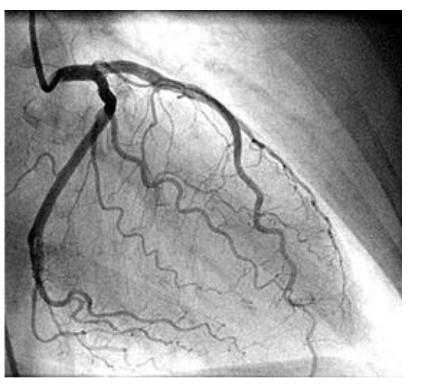
Your doctor (cardiologist) has referred you for a procedure in the cardiac catheterisation lab (cath lab). This is so they can either make a diagnosis or proceed with a treatment. X-rays are often used to allow the consultant to see the equipment being used (such as catheters and leads) and structures in your heart (such as coronary arteries, as seen below).
What are the benefits of using x-rays?
These cath lab procedures can sometimes greatly improve your quality of life or allow an early diagnosis of any problems you may have with your heart. The cardiologist will have weighed up the risk of using radiation and the benefits of having your procedure and decided that the benefits of you having your procedure will outweigh the risk of exposing you to radiation.
Radiation Dose in relation to you
We all receive radiation, known as ‘background radiation’ every day. If you have a procedure that uses x-rays it will result in you receiving an additional dose of radiation. Generally, the amount of radiation received during an X-ray examination is the equivalent of between a few days and a few years of exposure to natural ‘background radiation’ that you would receive from the environment. The level of dose varies with different types of X-ray examinations.
Some examples of Cath lab procedure x-ray doses at The Princess Alexandra Hospital are:
- Coronary angiograms result in doses that are equivalent of 3.2 years background radiation (risk of cancer = 1 in 2600)
- Percutaneous coronary intervention (PCI) is a coronary angiogram with insertion of stent(s) in a narrowed coronary artery. Stent(s) insertion in one coronary vessel can result in a dose equivalent of 10.5 years background radiation (risk of cancer = 1 in 850).
- Insertion of a pacemaker can result in a dose equivalent of 1.4 years background radiation (*risk of cancer = 1 in 6350).
*Risk of cancer is averaged for a 50-year-old.
The additional risk shown above should be considered in the context of the baseline cancer risk which is greater than 1 in 3. All X-ray doses are kept as low as possible to ensure that images of a high diagnostic quality are obtained without exceeding accepted dose levels.
Considerations you should make
Every exposure to X-rays carries a risk of causing cancer many years or decades later; however this risk is thought to be very small (NHS Choices, 2015).
More information on the typical doses received, equivalent periods of natural background radiation and lifetime fatal cancer risks from diagnostic medical exposures can be found on the NHS Choices website.
A baby in the womb can be particularly sensitive to the radiation. If you are, or think you may be, pregnant, please tell the radiographer before you have a cath lab procedure.
Consent
Please feel free to ask your doctor or the cath lab radiographer if you have any further questions. If you do not feel you have been given sufficient information you may refuse to have your cath lab procedure and go back to discuss this with the cardiologist who has referred you.
Contacting the team
f you have any further questions, please contact the Cardiology Cath lab team on:
- Telephone: 01279 827814/01279 827913
- Office hours: Mon to Thu 08:00 to 16:00
There is an answerphone available outside these hours. Please leave a message and a member of the team will contact you.
If you would like to give feedback on your care, please contact our patient experience team on [email protected] or 01279 827211.
Please contact the communications team on [email protected] or 01279 827926 if you would like this leaflet in another language or format.