
Peripherally Inserted Central Catheter (PICC) Line Insertion (287kB pdf)
Introduction
We hope this guide will answer your questions about your PICC line insertion. Please contact the team if you require further information via the details at the end of this leaflet.
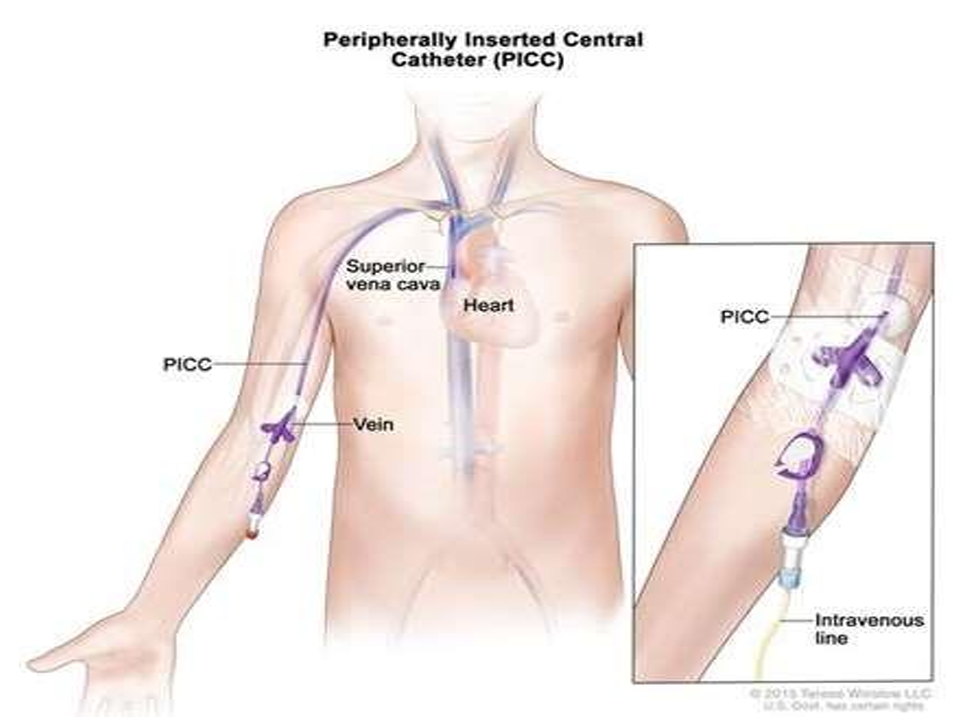
What is a PICC line?
PICC line is a Peripherally Inserted Central Catheter.
It is a long thin flexible tube that is inserted into a vein in your upper arm. The line is pushed along the vein until its tip reaches one of the large veins just above your heart. It can stay in place for the duration of your treatment.
Why do I need a PICC line?
It has been suggested that you have a PICC inserted because of your treatment plan. Reasons for catheter insertion will vary, and will depend upon your medical condition, and your proposed treatment. While your PICC line is primarily there to deliver your chemotherapy, it can also help make your care a bit easier and more comfortable. It can be used for taking blood samples and for giving other treatments you may need, such as antibiotics or intravenous fluids—meaning fewer needles and less discomfort overall.
Preparing for your procedure
Eating and drinking
You may eat as normal and if possible please hydrate really well the day before the procedure and the morning of the procedure – try and have at least 1 litre to drink.
Medication
Please continue taking any medications as prescribed. Inform the nursing staff on Williams Day Unit if you are on any blood thinning medication before the day of your procedure.
Clothing
Please wear a sleeveless or loose fitting short sleeved top for the procedure. Any metal or jewellery you have on will need to be removed for the procedure, this includes a bra with underwire.
Getting to us
Directions – We are based at the Williams Day Unit, Building 5, at The Princess Alexandra Hospital NHS Trust
When should I arrive?
Please arrive at the time of your appointment.
The day of the procedure
The procedure
- A Vascular Access Nurse will insert your PICC line, the procedure will be explained to you and you will be asked to sign a consent form.
- You will lay down on a procedure trolley, it can take 30 to 60 minutes.
- Local anaesthetic is used to numb the area around the vein prior to the procedure. This may be a little painful but no worse than a regular blood test. After that you may feel some pressure at the site.
- The nurse putting your PICC line in will wear a surgical gown and your arm will be covered with a surgical drape. Please do not be alarmed by this it is to ensure that everything is kept clean.
- Occasionally it may be difficult to insert the PICC line and the procedure will be unsuccessful or we may try the procedure in your other arm.
After the procedure
- After insertion once the local anaesthetic wears off it is very normal to have some discomfort or aching in the arm. There may be some bruising around the insertion site and blood on the dressing, this is nothing to worry about.
Risks and complications
- Infection: It is possible for an infection to develop around the area where the PICC line goes into the skin, it is very important to seek help if you develop signs of infection. Red, hot, pain, swelling, oozing at insertion site are all signs of infection call the number on your red alert card (see ‘Contacting the Team’ below). If your temperature goes above 37.5C you must attend the Emergency Department.
- Thrombosis: It is possible for a blood clot to develop in your vein anywhere along the length of the PICC. Symptoms can include pain in your arm, redness, swelling or hot/warm to touch, you must contact the number on your red alert card (see ‘Contacting the Team’ below). To help prevent this please use your arm normally, lift, carry and move things as you usually would – please do not ‘nurse’ the arm.
- Dressings: Occasionally you may develop an allergy to the dressing used to secure your line. If you have concerns please inform us and we can try alternative dressings.
- Misplacement: In some cases, the tip of the line may not be in the correct place. A chest X-ray is required to check the position and the line can be adjusted accordingly.
- Blocked PICC: Sometimes the line may block, this will prevent the line being used. A medication called alteplase can sometimes be used to unblock it and this can usually be done on the day of your treatment. If we cannot unblock it, the PICC will need to be removed and if still needed a new PICC will need to be inserted. Flushing of the PICC after each use; or weekly to 10 days flushing if the line is not in use, minimises the risk of the line becoming blocked.
Can I drive after my procedure?
You may drive yourself to and from the procedure so long as you feel well enough to do so.
Can someone stay with me in hospital?
You are more than welcome to bring someone with you but they will need to wait in the waiting area while the procedure takes place.
Caring for your line
Following your PICC insertion the dressing will be quite bulky and covered with a loosely fitted bandage, this will all need to be changed 24-48 hours after placement. This will be done at Williams Day Unit.
After this, your PICC dressing needs to be changed every 7-10 days. If you are having 2 weekly chemotherapy and are already attending 2-3 times in one week you should not need to come in for any additional visits for PICC line care unless there is a problem. If the dressing becomes loose please call the WDU on the number below. If your arm, becomes hot, painful or swollen at any time please call the number on your red alert card.
You do not need to make an appointment for PICC line maintenance please drop into the Williams Day Unit Monday – Friday between 9am – 10am, take a number from the waiting area and wait to be called through by one of the nurses.
Living with your line
You can lead a normal life with a PICC line but there are some things you need to be aware of.
- Bathing – You may shower with your PICC line in but will need to use a waterproof cover (this will be given to you at your PICC line insertion) If you have a bath the PICC line must be kept dry.
- Sports – Sports such as tennis and golf are discouraged as the PICC line may become displaced, you must not go swimming. Gentle exercise is fine to do so long as you feel well enough to do it.
- Working – There are no restrictions on working providing your doctor is happy for you to do so, avoid heavy lifting and manual work.
- Driving – There is no reason you cannot drive provided you feel well enough to do so.
- Holidays – You may go on holiday with a PICC line but travelling on a plane is not advisable. Please ensure the dressing has been changed before you go and will last until you come back.
Having you PICC line removed – Once your treatment is finished your line will be removed on the unit by one of the nurses, it is gently pulled out and is a painless procedure. A dry dressing will be applied which can be removed after 48 hours.
How soon can I return to work?
The Vascular Access Nurse can advise you on this. This will vary from person to person dependent on your occupation.
Contacting the team
If you have any further questions, please contact the Williams Day Unit on:
Telephone: 01279 827572
Office hours: 08.00 – 18.00 hrs. Mon – Fri
There is an answerphone available outside of these hours. Please leave a message and a member of the team will contact you.
Red Alert Card
Telephone: 07932 528323
Mon – Fri 08.00 – 18.00hrs
Out of Hours and Bank Holidays – Telephone: 07423 459076 (North Middlesex Hospital)
If you would like this leaflet in another language or format, or you would like to give feedback on your care, please contact our patient experience team on [email protected]