
Intermittent Self Catheterisation (ISC) (232kB pdf)
Introduction
We hope this guide will answer your questions about Intermittent Self Catheterisation (ISC). Please contact the team if you require further information via the details at the end of this leaflet.
What is Intermittent Self Catheterisation (ISC)?
Bladder Instillation is the term used to describe the process by which medication is directly introduced into the bladder through a small flexible tube called a catheter.
Hyacyst is the proprietary name for Sodium Hyaluronate. Sodium Hyaluronate is a naturally occurring substance that helps repair the protective layers of the bladder lining, which can be damaged through repeated urine infections and cystitis.
Why do I need to self catheterise?
Catheterisation is needed when the bladder is full and you are unable to pass urine naturally. There are many reasons why some people cannot pass urine without using a catheter such as overstretching of the bladder wall, leading to difficulty in emptying your bladder fully causing retention of urine; following abdominal or spinal surgery or trauma damaging the nerve supply to the bladder and genetic or degenerative disease that affects bladder function, are just some of the reasons why you may need to self catheterise even if only for a short period of time.
Some patients may also need to self catheterise following dilatation or incision of a urethral stricture as it is important to keep the urethra patent. Whilst the regime and number of times you will need to self catheterise will be different to those who do have a problem passing urine, the technique and procedure is the same.
Before you begin to self catheterise you must understand your anatomy and be able to locate the opening of the urethra. For men it is quite easy but it’s a little more difficult for women – see pictures below.
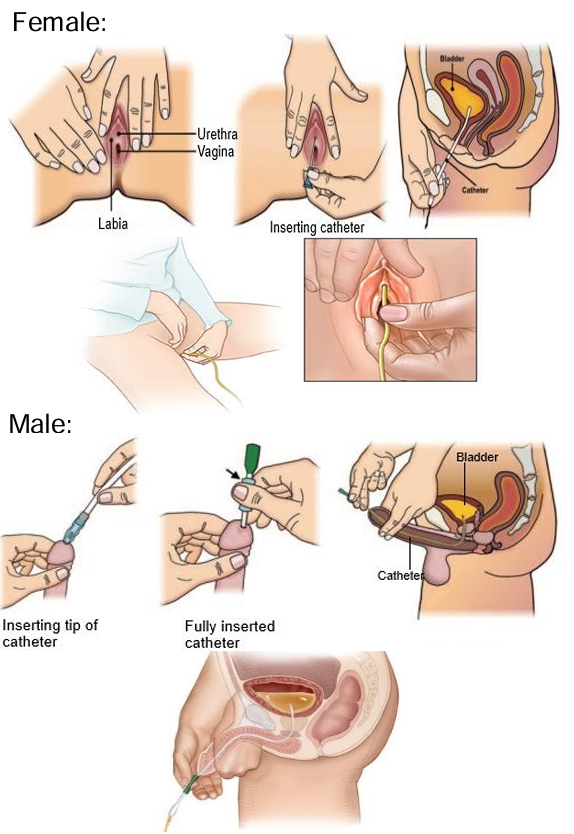
Once the decision to teach you to self catheterise has been made the nurse attending you will explain what this entails.
They will talk you through the procedure, show you a video of how to carry out ISC and show you a few different types of catheters for you to test.
Once you have been shown the video and understand what is required the nurse will ask you to carry out your first self catheterisation under supervision. Whilst this may feel a little embarrassing, it is important for the nurse to observe you undertake the procedure to ensure that you have a good technique and to be able help you should you encounter any particular problems with this first attempt.
Are there any risks with ISC?
As with any invasive procedure there are a few things to be aware of. Passing a catheter may cause some bleeding and may introduce an infection. This is why it is important to wash your hands and genitalia thoroughly prior to commencing ISC and to prevent cross contamination of the catheter.
By following the directions and instructions as explained by your nurse, maintaining strict aseptic conditions, and keeping relaxed, self catheterisation will be uncomplicated and will help reduce these potential risks.
With the right training, almost everyone can perform ISC safely, even children and people with limited mobility and dexterity.
How often will I need to do ISC?
Some patients need to self catheterise up to three times a day, whilst others only once a week. The nurse will advise you about how frequently you may need to self catheterise, and it is solely dependent on your individual circumstance and consultant instructions.
Where can I get a supply of catheters from?
Once you have decided on the catheter you feel comfortable with, your nurse will give you some catheters to take home and register you with a supplier who will deliver further catheters to your home. You will then be able to reorder directly from them, and details will be provided on how to do this before you leave the clinic.
The company liaises with your GP to organise the required prescription and then send out the catheters. Sometimes there can be a delay in getting this processed so remember to reorder when you are down to your last two weeks’ worth of catheters.
What happens after?
The nurse will arrange for you to have a follow up review appointment 2-3 weeks after your teaching. This is just to ensure that you are managing OK and not experiencing any undue problems, and provides opportunity for you to ask any questions you may have.
This may be a telephone call rather than a physical appointment, but if needed a face-to face appointment will be made.
You will also be given a Bladder Diary to help you to record your intake/ output’s which will be useful in reviewing frequency of ISC.
Should you experience any symptoms of infection, prolonged bleeding in your urine, or severe abdominal pain, please either call NHS Direct (111), or go to your nearest A&E department.
Contacting the team
If you have any further questions, please contact the Urology Booking Team on:
Telephone – 01279 962391 or 01279 952807
Office hours: 09:00 to 16:00
There is an answerphone available outside of these hours. Please leave a message and a member of the team will contact you.
If you would like this leaflet in another language or format, or you would like to give feedback on your care, please contact our patient experience team on [email protected]