
Hyacyst Bladder Instillation (243kB pdf)
Introduction
We hope this guide will answer your questions about Hyacyst Instillation. Please contact the team if you require further information via the details at the end of this leaflet.
What is a Hyacyst Bladder Instillation?
Bladder Instillation is the term used to describe the process by which medication is directly introduced into the bladder through a small flexible tube called a catheter.
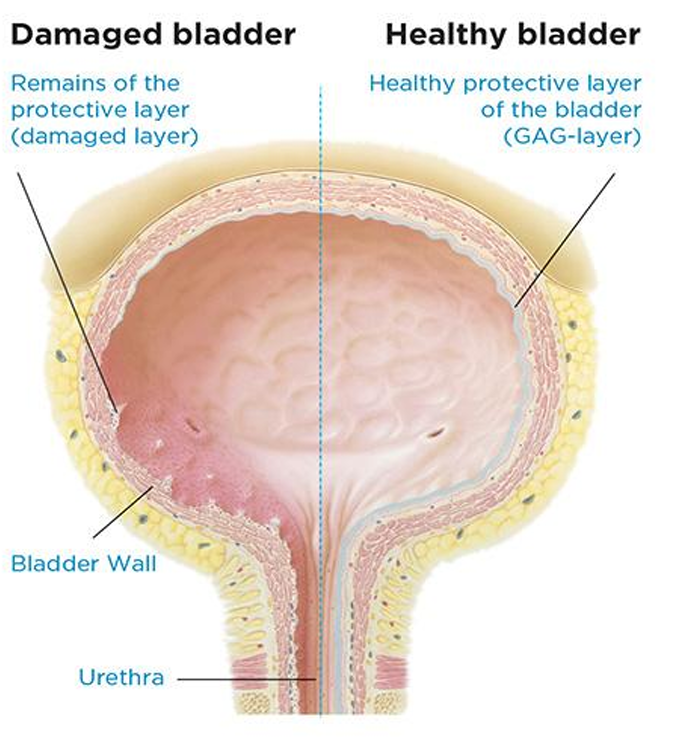
Hyacyst is the proprietary name for Sodium Hyaluronate. Sodium Hyaluronate is a naturally occurring substance that helps repair the protective layers of the bladder lining, which can be damaged through repeated urine infections and cystitis.
What is Hyacyst used for?
In a healthy bladder the lining is protected by a natural chemical called Glycosaminoglycan (GAG). GAG acts as a barrier against the chemicals and toxins naturally found in urine.
If the GAG layer becomes damaged it exposes the sensitive layers of the bladder to these toxins and chemicals which can cause irritation leading to;
- pain or burning sensation when passing urine, with or without associated infection
- increased bladder sensitivity causing pain especially on filling
- sudden onset sensation to pass urine (urgency)
- reduced bladder capacity
- lower abdominal/ pelvic pain
- any combination of the above
Hyacyst has been found to be most beneficial to patients who have repeated urine infections, Painful Bladder Syndrome or Interstitial Cystitis.
How does Hyacyst work?
Hyacyst contains a sterile, purified solution of Sodium Hyaluronate, a key component of the natural GAG layer. When instilled into the bladder, it creates a temporary barrier on the bladder lining surface, which then helps to repair the bladder’s natural GAG protective layer. Hyacyst helps to support the healing process for the bladder lining, and reduce the inflammatory response associated with infection.
What is Hyacyst administered?
Hyacyst is administered via a small catheter inserted into your bladder. Once the Hyacyst has been instilled the catheter is removed from your bladder.
What will happen on day of treatment?
The procedure only takes 10-15minutes to carry out and it is performed in the out-patient clinic.
On the day of your treatment you will be asked to provide a mid-stream urine sample for testing prior to having the treatment, and to empty your bladder.
Please be aware if there is a suspicion that you have an underlying urine infection, or there is a lot of blood in your urine (even non visible blood), then we may not be able to administer your treatment, but the nurse looking after you will be able to explain more detail to you at the time.
Assuming your urine is free from blood or infection you will be taken into the treatment room where the nurse may ask you some questions about your symptoms and history, before administering your treatment.
You will be asked to undress your lower half of clothing and lay on the couch. Your genital area will be cleaned with a sterile solution before the catheter is inserted through your urethra (water pipe) into your bladder where any residual urine will be drained.
The Hyacyst will then be instilled into your bladder through the catheter – approximately 50ml of fluid – once instilled the catheter will then be removed.
The Hyacyst should ideally be kept in your bladder for a minimum of 1.5hrs and a maximum of 2hrs. This allows the Hyacyst to treat the whole of the bladder lining.
On the first treatment we will ask you to stay with us for the 2hrs after the instillation. This is to allow you to understand what it feels like to hold the Hyacyst in your bladder for two hours, and to see if there is any undue reaction to the drug itself. We will then ask you to empty your bladder. For subsequent treatments you will not need to stay in the department and can leave after the Hyacyst has been administered.
Do I need to prepare anything before having Hyacyst?
In terms of general preparation, you should limit your fluid intake starting the night before your planned treatment, and should have NO fluids for 4 hours immediately prior to your treatment time.
This is to ensure that you can hold your urine longer reducing the risk of you needing to pass urine too soon whilst the drug is in your bladder, and reduce the amount of urine your body produces whilst having treatment.
If you take diuretics (water tablets) please let your nurse know, but you should not take your Diuretic medication on the day of treatment. You can take any other prescribed medications as normal.
Once the treatment has been instilled you should not drink for 2 hours after. You can have a light breakfast before your treatment if you wish, and although you cannot drink initially afterwards, you can have something light to eat.
Are there any side effects of Hyacyst?
- Hyacyst has a very low incidence of side effects but some patients may experience;
- increased urinary frequency and/ or urgency
- slight discomfort on passing urine
- non-visible trace of blood in urine
- urinary tract infection
Contacting the team
If you have any further questions, please contact the Urology Booking Team on:
Telephone – 01279 962391 or 01279 952807
Office hours: 09:00 to 16:00
There is an answerphone available outside of these hours. Please leave a message and a member of the team will contact you.
If you would like this leaflet in another language or format, or you would like to give feedback on your care, please contact our patient experience team on [email protected]