
Flexible Cystoscopy (243kB pdf)
Introduction
We hope this guide will answer your questions about Flexible Cystoscopy. Please contact the team if you require further information via the details at the end of this leaflet.
What is a Flexible Cystoscopy?
A Flexible Cystoscopy is a minimally invasive medical procedure to look inside your bladder using a thin flexible fiber-optic camera, called a Cystoscope.
The cystoscope is passed through your urethra (water pipe), into the bladder allowing the practitioner to look at the internal structure of your urethra and bladder.
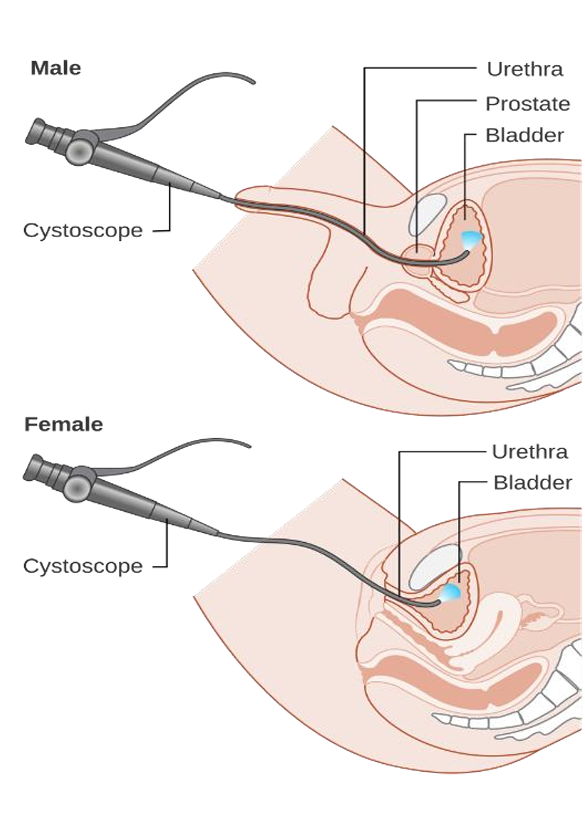
Flexible Cystoscopies are performed as an out-patient procedure under local anaesthetic
gel.
Why do I need a Flexible Cystoscopy?
Your doctor has recommended for you to have a Flexible Cystoscopy to investigate what might be causing your symptoms.
If you suffer with recurrent urine infections (UTI), pain on passing urine (Dysuria), urinary incontinence, have seen blood in your urine (Haematuria), or have been told that there is microscopic blood in your urine, a cystoscopy will help to identify the possible cause. It can also be used to carry out other diagnostic tests such as a biopsy, or to remove a stent.
What does a Flexible Cystoscopy involve?
The doctor or nurse practitioner performing the cystoscopy will explain in detail what will happen on the day but in general you will be asked to remove your lower half clothing and will be given a gown to wear. The doctor/ practitioner will talk you through the procedure and ask you to sign a consent form before continuing, once you have signed the consent you will be asked to lay on the procedure couch.
In the room will also be a nurse to assist the doctor/ practitioner, and sometimes a second nurse who will be there to support you if needed.
The doctor/ practitioner will clean your genital area with a sterile solution and then you will be covered with some sterile drapes. It is important that you keep your hands away from the area during the procedure to reduce the risk of you giving yourself an infection.
The doctor/ practitioner will then instil some local anaesthetic lubricating gel into your urethra which may sting a little as it also contains a local anaesthetic and an antimicrobial to reduce the risk of us giving you an infection.
Once the gel has been instilled the fiber-optic camera will be passed through your urethra into your bladder, and your bladder will then be filled with sterile water to open it up so it can be seen on the monitor; you will be able to see this too should you wish to.
Passing the cystoscope may be a little uncomfortable but should not be painful. For men the cystoscope also passes through the prostate which can cause some discomfort but it is important to keep relaxed as much as you can during the procedure and not clench your bottom or abdomen, as this will create a clamping effect on the scope and may make it more uncomfortable for you.
The doctor/ practitioner may take some pictures of the inside of your bladder as a record of what they have seen to enable your doctor to make a diagnosis where required.
Once the cystoscopy has been completed you will be able to use the toilet and following any specific discharge instructions will be able to leave the department.
Are there any risks or complications to consider?
Most patients have no problems after a cystoscopy but as with all diagnostic investigations there are a few things you need to be aware of.
Some patients experience a mild burning/ stinging sensation after a cystoscopy. This is partly due to the local anaesthetic and partly due to having a camera passed through your urethra. Drinking plenty of water afterwards will help flush through the local anaesthetic and help ease any discomfort.
Some patients may see some blood in their urine afterwards which can last for up to 24hrs so don’t be unduly alarmed. Again, drinking plenty of water will help flush any blood through.
Although every precaution is taken to reduce the risk, infection can happen following a cystoscopy. If you do develop an infection it is usually a few days after.
If you do experience a high temperature, fever, or any of these for longer than a few days then please contact your GP, NHS Direct, or your local A&E for advice.
What should I do following a Flexible Cystoscopy?
The nurse discharging you will explain in detail the Do’s and Don’ts before you leave but in general you should;
- drink approximately 1-1.5lts of water based fluids a day for a few days, as your own bacteria can be introduced into the bladder during a cystoscopy, which in a small number of patients can lead to an infection; by drinking plenty of fluids it can help to prevent this from occurring.
- avoid caffeinated or carbonated drinks such as Tea, Coffee or Coca-Cola on day of procedure as these aggravate the bladder and may cause over activity. You can drink decaffeinated drinks.
- avoid alcohol on day of procedure or reduce intake if possible Following the procedure, you may require further investigations or tests or you may be discharged back to your GP, in either case the practitioner performing the cystoscopy will discuss the plan with you before leaving.
Contacting the team
If you have any further questions, please contact the Urology Booking Team on:
Telephone – 01279 962391 or 01279 952807
Office hours: 09:00 to 16:00
There is an answerphone available outside of these hours. Please leave a message and a member of the team will contact you.
If you would like this leaflet in another language or format, or you would like to give feedback on your care, please contact our patient experience team on [email protected]