
Exercise treadmill test (take medication) Patient information leaflet (206kB pdf)
PLEASE NOTE: This is the Patient Information Leaflet for TAKING MEDICATION for the exercise treadmill test.
Introduction
We hope this guide will answer your questions about your Exercise Treadmill Test. Please
contact the team if you require further information via the details at the end of this leaflet.
IMPORTANT information ahead of your procedure:
- HOSPITAL TRANSPORT PATIENTS: Please ensure you make arrangements with transport for both arrival to hospital and return.
- Children are not allowed in the waiting area unattended. Staff are not permitted to supervise children so please ensure childcare arrangements are in place to avoid your appointment being rescheduled.
- Please allow enough time for parking to avoid your appointment being rescheduled. We advise allowing at least 20 minutes before your appointment slot to allow enough time to park your car, as parking is limited. You may want to leave your car in an offsite car park.
What is a Exercise Treadmill test?
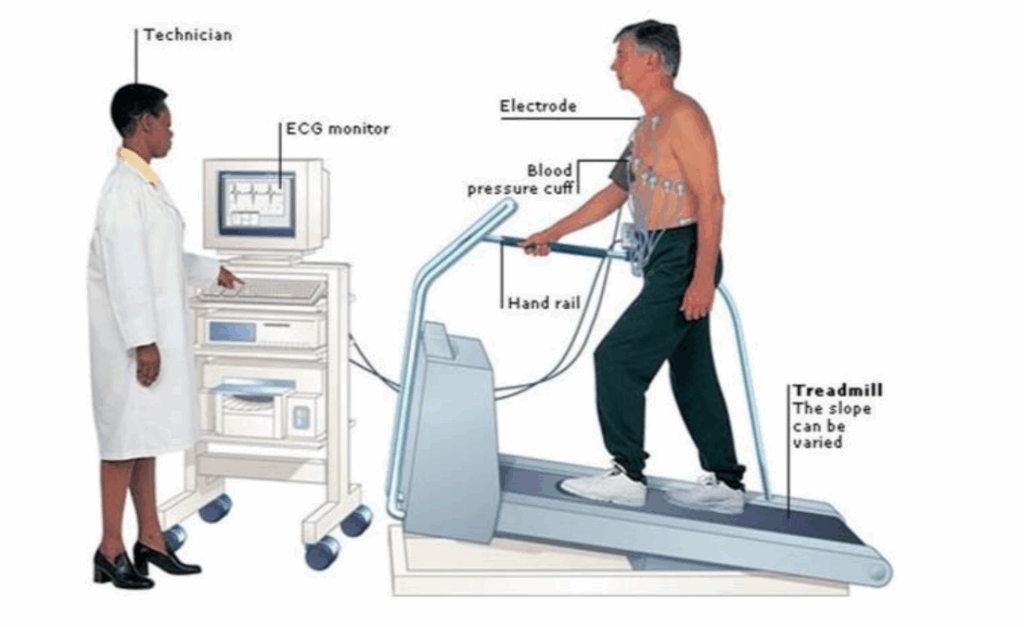
Exercise treadmill testing (also known as exercise tolerance testing) is a non-invasive
procedure where physically-able patients walk / jog on a medical treadmill. This test
provides information about the patient’s ability to exercise at increasing exercise
intensities while identifying any potential limitations (e.g. chest pain or shortness of
breath). Your heart rate and rhythm will be monitored on a screen throughout along with
your blood pressure.
Why do I need a Exercise Treadmill test?
Your doctor has requested that you have this non-invasive test in order to understand how the heart copes when it is made to work harder. An exercise test is useful to diagnose if you have angina or any possible problems with the blood flow to your heart muscle. It also helps to diagnose any problems with the rhythm of your heart during exercise.
Preparing for your procedure
- You should wear comfortable clothing and supportive footwear suitable for doing exercise, ideally a top and bottoms/trousers (dresses are not suitable).
- If you are pregnant or suspect you may be, please contact the department as it may not be advisable to proceed with the test
Medication
You should continue to take all of your usual medications unless stated on the important
information on the top part of this leaflet. Please bring a list of your current medications.
Getting to us
Once you have arrived at The Princess Alexandra Hospital (Hamstel Road, Harlow, Essex,
CM20 1QX), follow the signage to the cardiology reception, which is located on the ground floor, blue zone. Please let the receptionists know that you have arrived for your appointment.
When should I arrive?
Please arrive at the cardiology department approximately 10 minutes prior to your
appointment time. Unfortunately, if you are late we may have to reschedule.
The day of the procedure
On the day of the test, it is advisable that you do not have a heavy meal at least two hours prior to the test and avoid caffeinated drinks as they may affect the result. Other fluids can be consumed up to the start of your test and we do recommend you come to the test well hydrated.
An exercise test is a safe test but there are some risks involved. There is a risk of
developing an angina attack or heart arrhythmia, however you will be accompanied by two physiologists throughout the test should any problems arise during the test.
The procedure
You will be taken into the treadmill room and asked to undress to the waist (female patients may keep a bra on).
Stickers (called electrodes) will be put onto your chest to monitor your heart rate and
rhythm and your blood pressure will also be taken during the test. Some men may need to have a small area of their chest shaved in order for the electrodes to stick to the skin.
For this test you will be asked to walk on a treadmill which begins at a gentle speed and
incline. You will be encouraged to walk for as long as you can on the treadmill whilst your
body’s response to exercise is assessed. You’ll need to exercise to the best of your ability.
When you have completed the exercise, you’ll be monitored whilst you rest and your body recovers. We recommend that you then remain in the department waiting room for 15-30 minutes after the test to allow yourself time to fully recover.
After the procedure: Results
All results and relevant information will be forwarded to the referring doctor. If necessary, they will contact you to arrange a follow-up appointment to discuss your treatment.
Can I drive after my procedure?
You are allowed to drive with the blood pressure monitor in place, but it can affect your
driving abilities. We advise that you refrain from driving if possible.
Can someone stay with me in hospital?
You may have a friend or family member attend with you, but they will be asked to stay in the waiting area while you are having your examination.
How soon can I return to work?
You are able to return to work as soon as discharged from the department
Contacting the team
- If you have any further questions, please contact the Cardiology Department on: Telephone: 01279827195, Office hours: 09:00am-04:30pm
- There is an answerphone available outside of these hours. Please leave a message with your name and hospital number and a member of the team will contact you.
Your feedback matters
- If you would like to give feedback on your care, please contact our patient experience team at [email protected] or 01279 827211.
- Please contact the communications team at [email protected] if you would like this leaflet in another language or format.