
Angioplasty and / or Stent Insertion Patient information leaflet (192kB pdf)
Introduction
We hope this guide will answer your questions about your angioplasty and/or stent
insertion. Please contact the team if you require further information via the details at the end of this leaflet.
What is an angioplasty?
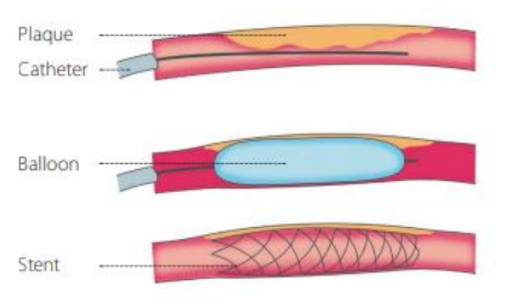
An angioplasty is a way of relieving a narrowing or blockage in a blood vessel without having an operation. A thin plastic tube (catheter) is inserted into the artery and passed through the blockage. A special balloon on the end of the catheter is placed across the narrowing or blockage. This balloon is inflated from outside the body momentarily and then deflated to improve the flow through the blood vessel
What is a stent?
A stent is a special device made of metal mesh that is placed across
a narrowing or blockage to keep the artery open.
Why do I need an angioplasty and / or stent examination?
Your doctor should have explained the reason why you need this test. It will help your doctor to decide on the cause of your symptoms giving clearer information to the specialists treating you Your doctor has identified that there is a narrowing or blockage in one of your blood vessels that is causing you a problem. If the arteries in your legs are affected, this may be causing pain in your calf or thigh. This may occur after you have walked a certain distance or may be causing more severe symptoms such as severe pain in your foot, especially at night. Other tests such as a Doppler ultrasound scan, a computed tomography scan (CTA) or a magnetic resonance scan (MRA) may have already been performed.
What are the associated risks?
X-Ray radiation: All x-ray procedures involve exposure to radiation in varying amounts. The dose you get from a medical x-ray is very low and your doctor along with the radiologists have determined that the benefits of having the examination outweigh potential risks. The radiographer is present throughout your test making sure that the radiation dose is kept as low as reasonably possible and the duration and level of x-rays are kept to a minimum.
Allergic reaction: A very small number of patients have an allergic reaction to the contrast medium (X-ray dye). This can be minor, severe, or even life threatening but the chances of this occurring are very rare, if you get an itchy rash or difficulty breathing during the procedure tell a member of staff, the team will provide appropriate treatment. Before your examination begins the radiographer will ask you a series of questions about your medical history, including any allergies you may have. This will help us assess if you are at risk of an allergic reaction to the x-ray dye.
Patients aged 12 to 55, could you be pregnant? X-rays can be harmful to an unborn
baby and should be avoided by patients who are or may be pregnant. It is recommended that the examination is performed within 10 days of the first day of your menstrual period. If your appointment is not within this time or if you think you may be pregnant, please contact the X-ray department before your appointment. When you arrive for your Angioplasty, you will be asked when your last period started. If it is more than 10 days earlier, your appointment may be postponed.
Breastfeeding: : During the procedure, you will be given an injection of contrast medium. These agents are low risk contrast agents. A very small percentage of the injected contrast enters the breast milk but virtually none is absorbed across the gut of the infant. No special precautions are required and you can carry on breastfeeding as normal. However, if you have any concerns you may want to express some breast milk prior to your appointment.
Will I need an injection?
Occasionally, patients are given antibiotics, sedative and painkillers through a cannula placed in your arm.
Preparing for your procedure
Please do not have anything to eat for 4 hours prior to your procedure. You may still drink clear fluids such as water. Please contact the booking team before your appointment if:
- you are or think you may be pregnant
- you have had a previous allergic reaction to contrast medium (X-ray dye) or are allergic to iodine.
- you are a diabetic taking Metformin.
- you weigh over 30 stone/190 kilograms
- you plan on using hospital transport or need a hoist to transfer
- you require an interpreter – please inform us as soon as you receive your appointment letter, and we will arrange an interpreter for you
If you are unsure or have questions about your preparation, contact your doctor or the X-ray department for advice.
Allergies
If you have asthma or any allergies, especially to iodine or X-ray contrast medium (X-ray dye), please inform us in advance.
Medication
If you are taking any blood thinning medication (Anti coagulation medication) you will be advised to stop for a certain period before the procedure. If you are taking warfarin you will be given a short course of alternative medicine.
Getting to us
Once you have arrived at The Princess Alexandra Hospital (Hamstel Road, Harlow, Essex,
CM20 1QX), follow the signage to the radiology reception, which is located on the ground floor, green zone. Please let the radiology receptionist know that you have arrived for your appointment.
When should I arrive?
Please arrive in the radiology department at your given appointment time. A notification
through text or letter should have been sent to you to confirm this appointment.
Can someone stay with me in hospital?
You may have a friend or relative attend with you, but they will be asked to stay in
the waiting area while you have your procedure.
Children are not allowed in the waiting area unattended. Our staff are not permitted to
supervise children, so please ensure child care arrangements are in place to avoid your
tests being rescheduled.
The day of the procedure
You will be shown to a cubicle and asked to undress and put on a gown; please bring a dressing gown if you have one. You may also be asked to remove jewellery, dentures, glasses, or other metal objects, which may show up on the X-rays.
The procedure
Your identification will be checked by a nurse and radiographer, a brief history will be taken; please tell the radiologist what medication, severe allergies, choking episodes or other medical conditions, such as thyroid disease and diabetes you may have. Before the procedure, the interventional radiologist will explain the procedure and ask you to sign a consent form. Please feel free to ask any questions that you may have and, remember that even at this stage, you can decide against going ahead with the procedure if you so wish. An angioplasty is performed under sterile conditions and the interventional radiologist and radiology nurse will wear sterile gowns and gloves to carry out the procedure. Your skin near the point of insertion, usually the groin area, will be swabbed with antiseptic and you will be covered with sterile drapes. The skin and deeper tissues over the blood vessel will be numbed with local anaesthetic. A needle followed by a wire and catheter (fine plastic tube) will be inserted into the artery and guided to the correct position to obtain the images required. Once the narrowing or blockage has been identified, a balloon is inflated to open up the artery and allow more blood to flow. Occasionally, the interventional radiologist will decide to place a stent (metal mesh) to keep the artery open. This is placed in exactly the same way as the balloon. Once the interventional radiologist is satisfied with the images, the catheter will be removed. Firm pressure will be applied to the skin entry point, for about ten minutes, to prevent any bleeding. Sometimes a special device may be used to close the hole in the artery.
Is it uncomfortable?
It may sting a little when the local anaesthetic is injected. You may feel a warm sensation for a few seconds when the dye is injected and feel like you are passing urine. Angioplasty is not painful although you may feel a little discomfort when the balloon is inflated.
After the procedure
Nursing staff will carry out routine observations including pulse and blood pressure and will also check the treatment site. You may be asked to lie flat in bed for 3-6 hours and then you will be able to go home. You will be allowed to eat and drink as usual, and if there are no complications or concerns, after monitoring, you may be allowed to go home the same day or the next morning.
Can I drive after my procedure?
No, it is important that you have a responsible adult to escort you home. You must not drive or use public transport for the journey home.
How soon can I return to work?
This will be advised by your attending physician.
When will I get my results?
You will not know the results of your examination immediately. The radiologist will report their findings to the clinician who arranged your procedure, who will discuss the results with you. It usually takes a couple of weeks for the results to become available.
Contacting the team
- If you have any further questions about your procedure or an existing appointment, please contact the radiology department (Monday to Friday, 9am to 4pm) at 01279 82 2527 or 3405
- If you have any queries outside of working hours (after 4pm and on weekends), you will be redirected to the main radiology reception. Please note appointment bookings cannot be made during this time.
Your feedback matters
- If you would like to give feedback on your care, please contact our patient experience team at [email protected] or 01279 827211.
- Please contact the communications team at [email protected] if you would like this leaflet in another language or format.