
ECG (electrocardiogram) Patient Information Leaflet (129kB pdf)
Introduction
We hope this guide will answer your questions about ECG (Echocardiogram). Please contact the team if you require further information via the details at the end of this leaflet.
IMPORTANT information ahead of your procedure to consider:
- HOSPITAL TRANSPORT PATIENTS: Please ensure you make arrangements with transport on return journey.
- If you are coming on a STRETCHER, please contact the department at 01279827195 to arrange a special appointment.
- Children are not allowed in the waiting area unattended. Staff are not permitted to supervise children so please ensure child care arrangements are in place to avoid your appointment being rescheduled.
- Please allow enough time for parking to avoid your appointment being rescheduled. We advise allowing at least 20 minutes before your appointment slot to allow enough time to park your car, as parking is limited. You may want to leave your car in an offsite car park.
What is an echocardiogram (ECG)?
An Electrocardiogram is also called an ECG. It is a diagnostic test that records the electrical activity of your heart. It gives information about your heart’s rhythm, and rate. It also gives information about the electrical system in your heart.
Why do I need an ECG?
Your doctor may refer you for an ECG as part of a general health check or if they suspect you have a heart condition. An ECG can be used to help diagnose and monitor conditions affecting the heart, such as:
- arrhythmias – where the heart beats too slowly, too quickly, or irregularly
- coronary heart disease – where the heart’s blood supply is blocked or interrupted
by a build-up of fatty substances - heart attacks – where the supply of blood to the heart is suddenly blocked
- cardiomyopathy – where the heart walls become thickened or enlarged
An ECG is usually one of the first tests you will have to check for heart problems. However, it does have some limitations, so often you will need to have additional tests to confirm a diagnosis.
Preparing for your procedure
- Please do not use body lotion, body oil, sun cream or talc the morning of
your appointment. - Consider wearing a loose-fitting top. You will be asked to undress from the
waist up. - Please contact us before your appointment if you require a male or female cardiac
physiologist, and we will do our best to accommodate your request. - You can eat and drink as normal
- You may be asked about any medicines you are taking, or any existing
cardiac conditions.
Medication
Please continue to take all medications as normal unless told otherwise by your doctor.
Getting to us
Please check which hospital your appointment is at. Below are the addresses for The Princess Alexandra Hospital in Harlow and St. Margaret’s Hospital in Epping.
- If you are attending The Princess Alexandra Hospital (Hamstel Road, Harlow, Essex,CM20 1QX).
- If you are attending St. Margaret’s Hospital (The Plain, Epping, Essex, CM16 6TN).
When should I arrive?
Please arrive at the cardiology department approximately 10 minutes prior to your
appointment time. Unfortunately, if you are late we may have to reschedule.
The day of the procedure
An ECG is a quick, safe and painless test. No electricity is put into your body while it’s carried out. On the day of your appointment, you will be invited to a private consultation room and will be asked to remove all of your clothing from your waist up (including a bra, if you are wearing one).
The procedure
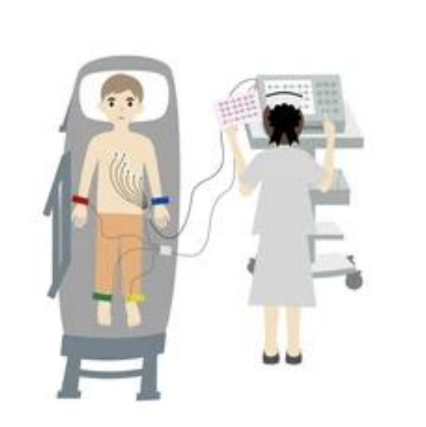
A cardiographer will prepare your skin by cleaning the area with an alcohol wipe. This is to ensure the electrodes stay in place. Chest hair may need to be shaved. Small electrodes (special stickers and wires) are attached to specific areas on your chest, wrists, and ankles. These electrodes will detect the electrical signals produced by your heart each time it beats. The signals will be recorded and converted by an ECG machine into a graph, which will either be displayed electronically or printed out on paper. The ECG recording will then be reviewed by your doctor to check for any unusual activity. During the test, you will need to lie as still as possible, as any sudden movements will make it hard to get a good quality recording. You may request to have a chaperone present during your ECG. An ECG usually takes between five and ten minutes.
After the procedure
You will usually be able to go home straight after the test.
Results
We will either send your results to the hospital consultant who referred you for this test or directly to your GP. You will usually be given your results during your next clinic appointment with your hospital consultant.
Can I drive after my procedure?
You are able to drive as soon as you are discharged from the department.
Can someone stay with me in hospital?
You may have a friend or family member attend with you, but they will be asked to stay
in the waiting area while you are having your examination.
If you would like a chaperone, please speak to a member of our team before your
appointment.
How soon can I return to work?
You are able to return to work as soon as discharged from the department.
Contacting the team
If you have any further questions, please contact the Cardiology Department on:
- Telephone: 01279827195
- Office hours: 09:00am-04:30pm
There is an answerphone available outside of these hours. Please leave a message with your name and hospital number and a member of the team will contact you.
Your feedback matters
- If you would like to give feedback on your care, please contact our patient experience team at [email protected] or01279 827211.
- Please contact the communications team at [email protected] if you would like this leaflet in another language or format.